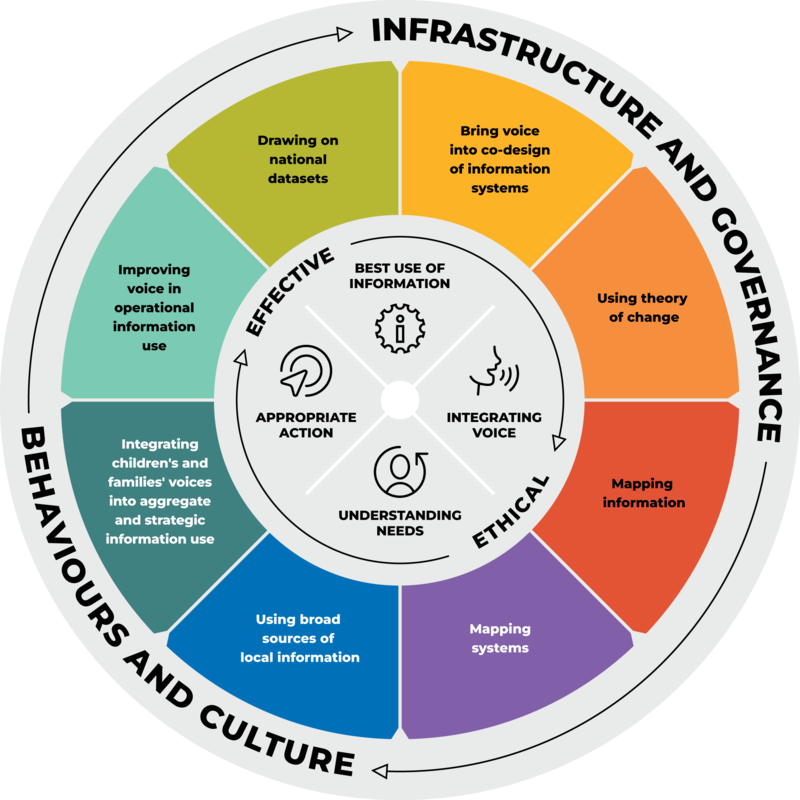
At the outset of our work, the CIP team specified five core Practices for information use: voice, data, ethics, use and learning. This specification has since evolved through our collaborative work with partner local authority sites, consultation with a wider Learning Network and broader engagement with the field. We have now developed – and are continuing to refine – a Framework to define, map, and support ethical and effective use of children’s information.
We plan to use this Framework in 2026 to support discussion with children, families and practitioners about uses of information and to review current Practice across England. The Framework will also support work to develop accessible materials to guide improved information practice.
The Framework identifies:
Four core high-level Approaches that are essential for ethical and effective information use:
1. Integrating voice
2. Understanding needs
3. Making best use of available information
4. Ensuring appropriate action and learning
Eight information use Practices required to achieve the ambition of ethical and effective information use:
1. Bringing voice into co-design of information use
2. Using theory of change to improve information use
3. Mapping information
4. Mapping systems
5. Using broad sources of local information
6. Integrating voice information into aggregate and strategic reporting
7. Improving voice in operational information use
8. Drawing from national datasets
Two sets of Enablers of supportive continuous learning and implementation to underpin and sustain these Approaches and Practices:
1. Infrastructure and governance
2. Behaviours and culture
In this Framework, infrastructure means the data architecture, standards, platforms and tools needed to collect, store, share and analyse information. Governance includes the policies, agreements and monitoring mechanisms that ensure data quality, privacy and interoperability as well as compliance across organisations and ethical use. Governance also clarifies roles and accountability mechanisms to ensure robust leadership at all levels while effectively managing risk. Together, infrastructure and governance create the essential environment for consistent, transparent and responsible information use.
Behaviours and culture are the shared values, norms, attitudes, and Practices within and across organisations that influence how information is perceived, valued and used. These include leadership commitment to data-driven decision-making, openness to collaboration, trust among stakeholders and a learning mindset. A positive information culture promotes transparency, accountability and continuous improvement, enabling staff at all levels to engage confidently with data. By fostering behaviours and cultural norms that prioritise responsible, ethical and effective information use, systems can maximise the value of data to inform policies, drive innovation and improve outcomes.
Integrating these general Enablers with the Approaches and Practices more specific to information use will help us to refine the Framework further before the publication of our final project report in autumn 2026.